

Democracies without borders inevitably collapse.
Suddenly. Like water that boils at 100°C.
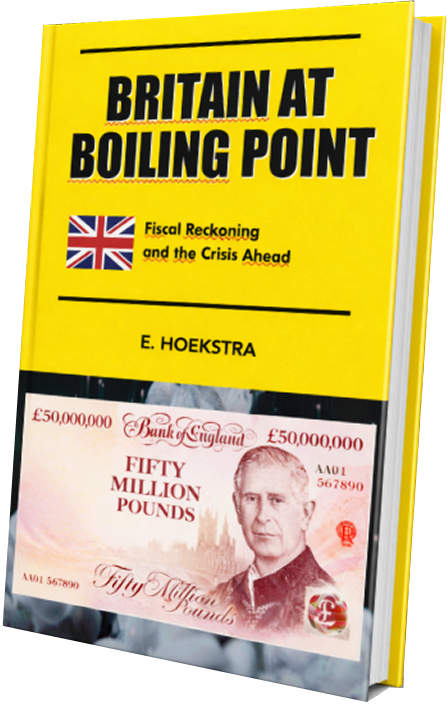
Water boils at 100 degrees Celsius. Suddenly. Economies under unsustainable pressure collapse the same way.
We live in a system where the real tax burden approaches 70 percent. Where governments — beyond democratic oversight — systematically build infrastructure for digital control: ail-in legislation that can confiscate your savings, central bank digital currencies that can track and block every transaction.
When All Hell Breaks Loose reveals how only 20 percent of the population — the Productive Core — carries the system, while they have minimal voting power. It shows why taxation isn’t about percentages, but about time confiscation: an effective burden of 50 percent means you work more for the state than for yourself.
This is no crash porn. No conspiracy theory. It’s an analytical warning based on historical patterns — from Rome to Weimar, from Argentina to Greece. For Canada, this book outlines the possible scenario of 2030-2035. Systems don’t break gradually. They collapse suddenly.
This book is based on facts. The numbers are verifiable. The pattern is visible. But only if you’re willing to see the complete picture do you understand the severity of the situation.
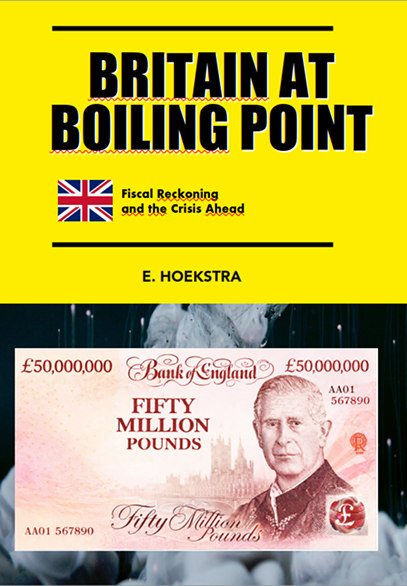
The water is reaching BOILING POINT.
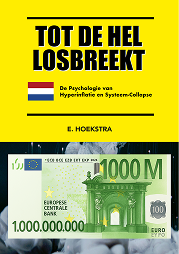
It’s happening
in

It’s happening
in

It’s happening
in
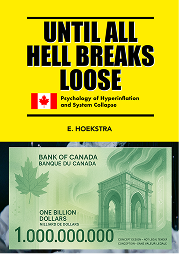
It’s happening
in
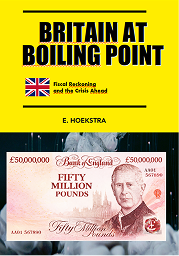
It’s happening
in
and soon also:
and more …
What makes Britain’s situation particularly instructive for this book’s thesis is the combination of six factors that do not apply, or do not apply simultaneously, in any other country examined.
First, the NHS. Britain’s National Health Service is the closest thing the country has to a national religion. It is funded from general taxation at approximately £170 billion per year, it employs 1.4 million people, it is universally beloved in principle and universally criticised in practice, and no political party can propose fundamental reform without electoral annihilation. The NHS is, in the analytical framework of this book, the single largest component of Segment A+ — the Circular Class — in any country we examine. Its fiscal demands are open-ended, its workforce is a political constituency, and its emotional hold on the national imagination makes rational discussion of its sustainability functionally impossible.
Second, the class system. Britain’s political economy cannot be understood without reference to a class structure that, while less rigid than a century ago, still shapes electoral behaviour, cultural attitudes, and institutional reflexes. The Productive Core — the entrepreneurs, professionals, and high earners who fund the system — is culturally associated with “wealth” in a country where wealth remains faintly disreputable. The political discourse of “fair share” operates against a background of class resentment that gives it a moral force absent in countries with less fraught histories of social stratification.
Third, post-Brexit isolation. Britain left the European Union in 2020 and has since discovered that sovereignty, whatever its constitutional merits, does not reduce fiscal obligations.
This British edition is not a translation. It is a re-contextualisation — the same analytical framework, applied to a different country, using different data, different history, and a rather different sensibility.
The original analysis was written in Dutch, for a Dutch audience. A Canadian edition followed, adapted to the realities of federal governance, equalization payments, and continental integration with the United States. A French edition localised the analysis for the country that, with government spending at 57 per cent of GDP and the Gilets Jaunes still fresh in memory, may represent the most advanced case of the trajectory this book describes. This UK edition is the fourth in a series that continues to grow — Spanish and Italian editions are in preparation — because the mechanisms documented here are not national curiosities. They are the shared pathology of Western welfare states, and each new country examined strengthens the case that the pattern is structural, not accidental.
The mechanisms described in this book are universal. Democracy without constitutional spending limits produces unbounded promises. Unbounded promises produce unsustainable fiscal commitments. Unsustainable commitments produce either reform or crisis. These dynamics play out across every Western democracy, and they play out with particular force in Britain — a country with total government spending at 45 per cent of GDP, national debt above 100 per cent of GDP for the first time since the 1960s, and approximately £3 trillion in unfunded long-term commitments that no mainstream politician mentions in public.
Every country covered by this series believes it is somehow exceptional — that the patterns documented in other nations do not quite apply at home. Canada believes its moderation will save it. The Netherlands believes its institutional competence will prevent the worst. Britain, characteristically, believes that it will muddle through.
Muddling through is, admittedly, a strategy with a distinguished track record. Britain muddled through the IMF crisis of 1976, when the Chancellor went cap in hand to Washington. It muddled through Black Wednesday in 1992, when sterling crashed out of the Exchange Rate Mechanism and the Treasury spent £3.3 billion in a single day trying to prop up the currency. It muddled through the financial crisis of 2008, when the government nationalised half the banking system. And it muddled through the Truss crisis of September 2022, when forty-four days of governance produced a gilt market crisis that nearly collapsed the pension system and required £65 billion in emergency
Each of these episodes was treated, at the time and subsequently, as an aberration — an isolated event produced by specific policy errors, resolved by specific corrections, and unlikely to recur. The pattern they collectively reveal — a system under increasing stress, with each crisis larger, more frequent, and more narrowly survived than the last — is not discussed.
What makes Britain’s situation particularly instructive for this book’s thesis is the combination of six factors that do not apply, or do not apply simultaneously, in any other country examined.
First, the NHS. Britain’s National Health Service is the closest thing the country has to a national religion. It is funded from general taxation at approximately £170 billion per year, it employs 1.4 million people, it is universally beloved in principle and universally criticised in practice, and no political party can propose fundamental reform without electoral annihilation. The NHS is, in the analytical framework of this book, the single largest component of Segment A+ — the Circular Class — in any country we examine. Its fiscal demands are open-ended, its workforce is a political constituency, and its emotional hold on the national imagination makes rational discussion of its sustainability functionally impossible.
Second, the class system. Britain’s political economy cannot be understood without reference to a class structure that, while less rigid than a century ago, still shapes electoral behaviour, cultural attitudes, and institutional reflexes. The Productive Core — the entrepreneurs, professionals, and high earners who fund the system — is culturally associated with “wealth” in a country where wealth remains faintly disreputable. The political discourse of “fair share” operates against a background of class resentment that gives it a moral force absent in countries with less fraught histories of social stratification.
Third, post-Brexit isolation. Britain left the European Union in 2020 and has since discovered that sovereignty, whatever its constitutional merits, does not reduce fiscal obligations. The post-Brexit settlement removed the UK from EU fiscal disciplines without replacing them with domestic equivalents. Britain now operates with less external constraint on government borrowing than at any point since the Second World War — and the trajectory of that borrowing suggests the constraints were not, in retrospect, entirely unwelcome.
Fourth, the Truss precedent. In September 2022, the gilt market demonstrated that Britain’s fiscal credibility could evaporate in days rather than years. The Truss mini-Budget — which proposed unfunded tax cuts of approximately £45 billion — triggered a market response so violent that the government fell within six weeks. This is not ancient history. It is a data point, and a recent one. The UK gilt market is capable of imposing discipline that the political system cannot. When the crisis documented in this book arrives — if it arrives — the mechanism of transmission is already known: gilt yields spike, pension funds face margin calls, the Bank of England is forced to choose between inflation and financial stability, and the government discovers that its fiscal room for manoeuvre has vanished overnight.
Fifth, the intellectual genealogy. The fiscal trajectory described in this book did not emerge by accident. It has a pedigree, and that pedigree leads back to a particular building on Houghton Street in central London. The Fabian Society, founded in 1884 and named after the Roman general Fabius Maximus — “the Delayer,” who defeated enemies through patient attrition rather than direct confrontation — has been the intellectual engine of British statism for over a century. The Fabians founded the London School of Economics in 1895, co-founded the Labour Party in 1900, and provided the ideological architecture for the welfare state that Clement Attlee’s government built after 1945. Sidney Webb’s concept of “the inevitability of gradualism” — the thesis that socialist ideas would permeate all parties and all institutions until the expansion of the state became the unchallenged consensus — is perhaps the most successful political strategy in modern British history. It is also, from the perspective of this book, the strategy that produced the boiling point.
The Fabian method was never revolution. It was permeation: the patient placement of ideas and people into positions of influence — civil service, academia, media, and eventually all major political parties — until the expansion of state power became the default assumption of governance. The LSE, which the Fabians created expressly for this purpose, educated the governing class. Anthony Giddens, the LSE’s director, formulated the “Third Way” that became Tony Blair’s ideological framework. Blair himself unveiled the Fabian Window — a stained-glass panel depicting Fabians reshaping the world — at the LSE in 2005. The lineage is not hidden. It is celebrated.
What matters for this book is not the Fabian Society as an institution — it is now a modest think tank producing pamphlets — but the Fabian method as the governing logic of British policy for over a century. Gradualism works. The state expanded incrementally, tax by tax, programme by programme, institution by institution, until government spending reached 45 per cent of GDP and unfunded commitments reached £3 trillion. No single step was revolutionary. No single Budget was catastrophic. Each expansion was presented as reasonable, limited, and necessary. The compound effect, over a century, was the fiscal trajectory this book documents. Webb was right: gradualism was inevitable. What he did not foresee — or did not care to examine — was what happens when the gradualist expansion of the state meets the arithmetic of fiscal sustainability. That collision is the subject of the twenty-one chapters that follow.
Lee Kuan Yew, Singapore’s founding prime minister, who studied at the LSE and absorbed Fabian ideas as a young man, offered a retrospective verdict decades later: “We did not see until the 1970s that that was the beginning of big problems contributing to the inevitable decline of the British economy.” He saw — too late, in his own telling — that the Fabian vision of a comprehensive welfare state contained within it the seeds of fiscal unsustainability. Britain, which exported Fabian ideas to its colonies and to the world, has yet to reach the same conclusion about itself.
Lee Kuan Yew, Singapore’s founding prime minister, who studied at the LSE and absorbed Fabian ideas as a young man, offered a retrospective verdict decades later: “We did not see until the 1970s that that was the beginning of big problems contributing to the inevitable decline of the British economy.” He saw — too late, in his own telling — that the Fabian vision of a comprehensive welfare state contained within it the seeds of fiscal unsustainability. Britain, which exported Fabian ideas to its colonies and to the world, has yet to reach the same conclusion about itself.
Sixth, the scale of unfunded commitments. The state pension, public sector pensions, PFI contracts, nuclear decommissioning, and NHS capital requirements together represent approximately £3 trillion in long-term obligations — commitments that are legally or politically binding but for which no provision has been made. This figure does not appear in the national debt statistics. It does not feature in Budget speeches. It is, by any reasonable accounting standard, the country’s true fiscal position, and it is roughly three times larger than the official debt figure that politicians cite when they wish to appear concerned about fiscal responsibility.
Britain is not in crisis today. But the trajectory is clear, the warning signs are recent, the intellectual architecture that produced that trajectory has been in place for over a century, and the capacity for self-correction — the fabled ability to “muddle through” — is being tested against pressures that previous generations did not face.
A note on register. This book is not an academic treatise, though it cites academic sources where relevant. It is not a political manifesto, though politicians of various persuasions will find material that confirms their prejudices and material that challenges them. It is not an exercise in doom-mongering, though the scenarios it describes are not comfortable reading.
The register we have aimed for throughout is that of a conversation in a good pub with an intelligent friend — someone who has spent rather too long looking at the numbers and wants to explain, clearly and without jargon, why the intuition that “something isn’t quite right” is not paranoia but arithmetic. The tone is British: understated where the facts are alarming, occasionally sardonic where the ironies are too pointed to resist, and always respectful of the reader’s intelligence. We do not tell you what to think. We show you the arithmetic and invite you to draw your own conclusions.
If the occasional sentence reads as though it was written with a dry martini to hand — well, some subjects are best approached with a measure of composure.
In the 2024-25 tax year, Tax Freedom Day in Britain fell on 25 April. Every pound earned from 1 January to late April went to the state — through income tax, National Insurance, council tax, VAT, fuel duty, insurance premium tax, stamp duty, and the dozen other levies documented in detail in Chapters 5 and 6.
These are not political talking points. They are arithmetic. And most Britons have never done the calculation.
This book explains why the burden keeps rising, why the promises keep expanding, and why the system driving both is fundamentally unstable. It explains why the NHS is simultaneously underfunded and unaffordable. Why the state pension is a promise the country cannot keep. Why house prices have outstripped wages for three decades. Why your children’s generation will be poorer than yours — the first time this has happened since the Industrial Revolution.
These are not opinions. They are measurable facts, documented with sources throughout. The question is not whether they are true, but what they mean for the stability of the system we all depend on.
These are not political talking points. They are arithmetic. And most Britons have never done the calculation.
These are not political talking points. They are arithmetic. And most Britons have never done the calculation.
This is not crash porn. We do not sensationalise. We describe mechanisms and historical patterns. Whether Britain actually experiences the crisis scenarios outlined in Chapters 15 to 18 depends on choices being made now — choices that, for the most part, are not being made.
This is not conspiracy theory. We accuse nobody of malice. Most policymakers act with good intentions. But good intentions have never guaranteed good outcomes, and systems can produce catastrophic results even when every individual actor behaves rationally. The road to fiscal crisis is not paved with villainy; it is paved with electoral promises.
This is not a political manifesto. Labour and Conservative governments have both contributed to the trajectory described here. The dynamics are structural, not partisan. We do not advocate for a specific party, and readers of every political persuasion will find both confirmation and discomfort in these pages.
And this is not an academic paper. We cite sources. We document our claims. But the goal is understanding, not scholarly completeness. This book is written for the intelligent citizen who wants to know why the system feels increasingly precarious — and whether that feeling is justified.
It is.
Primarily, this book addresses what we call the Productive Core — the 18 to 20 per cent of the population whose tax contributions fund the rest. The entrepreneurs, the professionals, the high earners, the small business owners who carry the fiscal system on their shoulders and who, increasingly, wonder whether the burden is sustainable and whether remaining in Britain is rational.
For them, this book is a mirror. It explains why their growing frustration is not selfishness but a rational response to arithmetic. It documents why emigration — to Portugal, to Dubai, to New Zealand, to anywhere the fiscal bargain is less punitive — is accelerating among precisely the people Britain can least afford to lose. And it shows why the political system cannot address their concerns, because the electoral mathematics make reform impossible without the support of the very constituencies that benefit from the status quo.
But this book is also written for the broader middle class — the Segment B of our framework — who sense that something is wrong, who see their living standards eroding despite working hard, who wonder why public services are deteriorating despite rising taxes, and who suspect that the answers they receive from politicians are incomplete. For them, this book provides the missing arithmetic.
And it is written for the policymakers, civil servants, and political advisers who know, privately, that the fiscal trajectory is unsustainable but who are trapped in institutions that reward optimism and punish candour. For them, this book is an invitation to be honest — not about politics, but about mathematics.
The book follows a logical progression from mechanisms to consequences.
Part I – The Mechanisms (Chapters 1–4): explains how the system works: what taxation really costs, how the population divides into economic segments, how money is created from nothing, and how technocratic institutions capture the policy agenda.
Part II – The Reality (Chapters 5–8): documents the current position: the true tax burden when all layers are counted, the scale of unfunded commitments, and the infrastructure of control being built for when the system comes under pressure.
Part III – The Dynamics (Chapters 9–12): analyses why the system is unstable: electoral mathematics that favour unsustainable promises, tipping points that trigger sudden change, and accelerators that amplify small shocks into systemic crises.
Part IV – The Tipping Points (Chapters 13–14): models what happens when the system breaks: triggers, unravelling, trust collapse, and the political vacuum that follows.
Part V – Reflection (Chapters 15–17): asks what comes after: the democracy paradox, the alternatives that were never chosen, and a letter to the next generation.
Two case studies follow the main text, as in every edition of this series. The Canadian edition examined the trucker convoy and Alberta’s regional alienation. The French edition analysed the Gilets Jaunes and the structural crisis of the French social model. This UK edition examines two episodes that illuminate the same dynamics in distinctly British form. The first — The Farmers’ Revolt — examines what happens when a productive minority organises, mobilises, and forces the state to retreat. The second — The Unspeakable Arithmetic — examines the fiscal trajectory that the political system cannot discuss. Together, they illustrate the book’s central tension: between collective resistance and individual exit, between voice and departure, between fighting the system and leaving it behind.
This book was written during 2025 and early 2026. The Labour government elected in July 2024 with a 174-seat majority had, by the time of writing, already confronted the fiscal realities that this book describes: the Autumn Budget of October 2024 raised taxes by £40 billion, the largest increase in a generation, and still left the OBR forecasting rising debt as a share of GDP. The farmers had marched. The immigration figures had peaked and begun to fall. The gilt markets remained calm — for now.
Nothing in this book depends on specific political events remaining current. The mechanisms described here operate regardless of which party holds power, which chancellor delivers the Budget, or which crisis happens to dominate the headlines. The arithmetic is structural. It was true under the Conservatives. It is true under Labour. It will be true under whoever governs next.
The question this book raises is not whether the fiscal trajectory is sustainable. The OBR’s own projections confirm that it is not. The question is whether the political system can reform before crisis forces it, or whether Britain — like every other country that has followed this path — will wait until the arithmetic becomes impossible and the choices become brutal.
Water boils at 100°C. The transformation is sudden, but the heating is gradual. This book describes what happens as the temperature rises. It is up to us — citizens, voters, taxpayers — to decide whether we turn down the heat before it boils, or keep hoping that the laws of physics won’t apply this time.

Erik Hoekstra is an entrepreneur and author.
Besides economic analyses, he writes about consciousness and ancient wisdom in his “Generative Thinking” series.
More on:
Any questions or comments? Feel free to send us a message!